Field Guide No. 07
Understanding Soil
Healthy soil, healthy garden, healthy planet
Soil is the foundation of everything you grow. Knowing your soil and improving it naturally leads to stronger plants, fewer problems and better results — with less watering, less feeding and less work.
A quiet read — around 9 minutes.
Why it matters
- Good soil holds nutrients, water and air, and gives roots somewhere to go.
- Healthy soil supports roots, microbes and the fungal networks that feed them.
- Improved soil means far less need for chemical inputs.
- Resilient soil helps your garden through both drought and downpour.
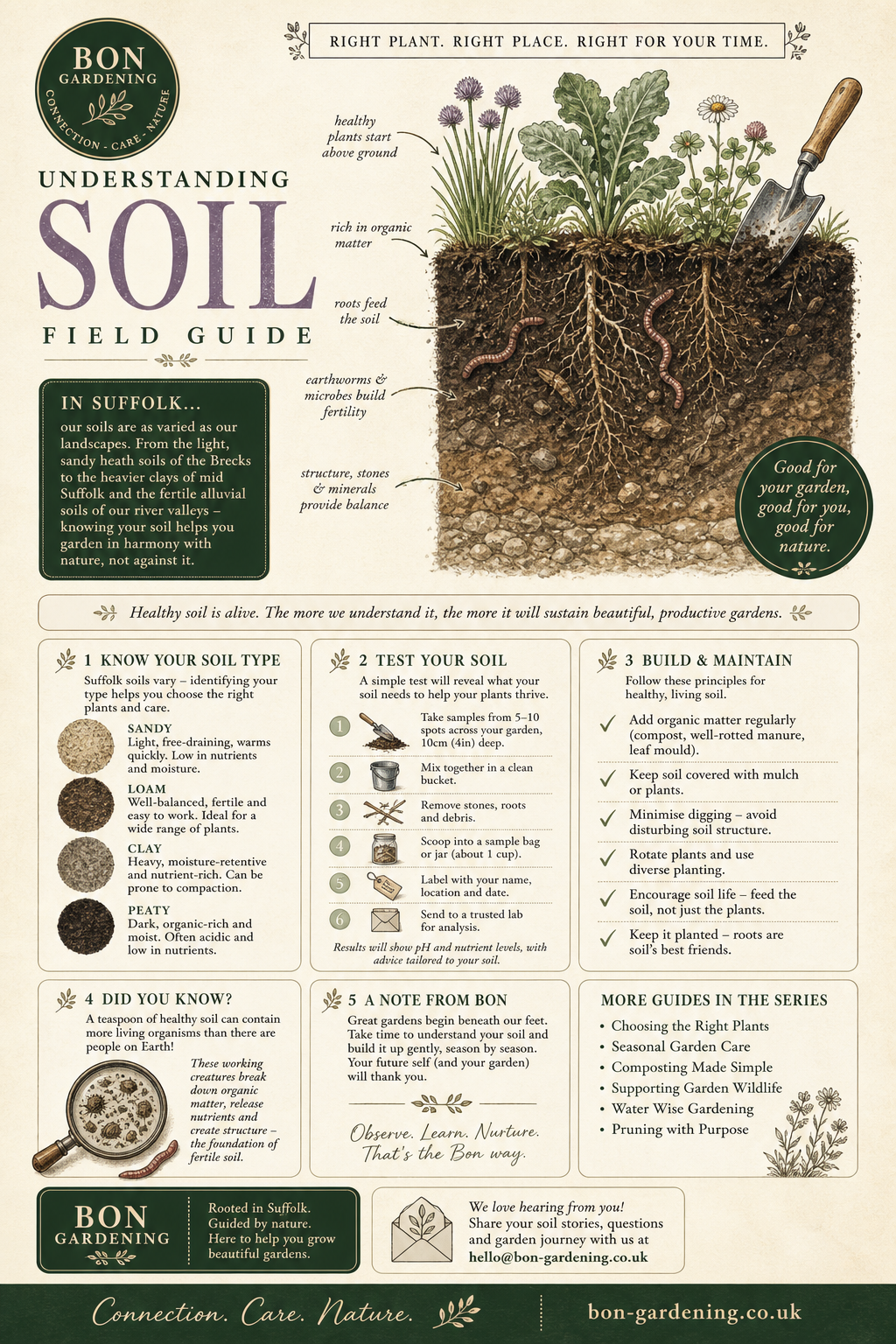
Soil types in Suffolk
Our soils range from sandy and free-draining to heavy clay. Know what you've got.
Sandy soil
Common across the Sandlings and the Brecks. Free-draining, warms up quickly in spring, easy to work — but nutrients wash straight through and it dries out fast.
TipAdd organic matter twice a year and mulch to retain moisture. Suits lavender, cistus, alliums and Mediterranean planting.
Silty soil
Found in river valleys. Rich and fertile, good water-holding, but compacts easily and can cap after heavy rain.
TipKeep it covered, add compost regularly and avoid walking on wet beds.
Clay soil
Widespread across central and mid Suffolk. Holds nutrients and water well, but is cold in spring, sticky when wet and sets hard in a dry summer.
TipImprove drainage with grit and bulky organic matter. Never work it when wet — you will destroy the structure.
Chalky soil
Shallow over chalk in places, free-draining and alkaline. Iron and manganese can be locked up, causing yellowing on acid-lovers.
TipChoose lime-tolerant plants rather than fighting the pH. Add plenty of organic matter and mulch.
Peaty soil
Dark, organic-rich and moisture-retentive, often acidic and low in some nutrients. Localised in fen margins.
TipNever buy peat to improve soil — use garden compost, leaf mould or well-rotted manure instead.
Loam
The balance of sand, silt and clay every gardener wants. Fertile, workable and moisture-retentive without waterlogging.
TipLoam is made, not just found — years of organic matter move any soil towards it.
How to test your soil
Two minutes with a handful of moist soil tells you most of what you need.
- Take a handful of moist soil from 10 cm down, away from recently mulched ground.
- Squeeze it in your hand and open your palm.
- Sand falls apart. Clay holds shape and smears shiny. Loam holds shape, then crumbles.
- Smell it — healthy soil smells sweet and earthy, the scent of active soil life.
- For pH, use an inexpensive kit and test several spots; much of Suffolk is neutral to alkaline.
- For a full nutrient picture, send samples from five to ten spots, mixed, to a soil lab.
Improve your soil
Simple steps, natural results — repeated every year.
- Add plenty of compost or well-rotted manure, ideally in autumn or early spring.
- Mulch all year round to 5 cm, keeping it clear of woody stems and crowns.
- Grow green manures in empty beds over winter — phacelia, field beans or grazing rye.
- Avoid digging where you can; use no-dig methods and let roots and worms do the work.
- Keep soil covered and fed with organic matter rather than left bare to bake and erode.
- Encourage worms, fungi and soil life; they build the structure you cannot buy.
Quick notes
- Feed the soil, not just the plant.
- Little and often is better than big and rare.
- Nature does the digging — worms and roots.
- Compost is black gold; make it on site wherever possible.
- Healthy soil equals a healthy garden. Everything else follows from it.
Did you know?
One teaspoon of healthy soil can contain more micro-organisms than there are people on Earth.
Mycorrhizal fungi extend a plant's effective root system many times over, trading water and nutrients for sugars — one good reason to disturb soil as little as possible.
It can take several centuries for nature to build a single centimetre of topsoil. A season of mulching is a small contribution to a very long project.
Living soil is full of life — the more you feed it, the more it will feed your plants.
Bon Gardening Field Guides are written with Suffolk gardens in mind. Every garden is different, so these guides offer practical principles rather than fixed rules.