Field Guide No. 04
Low-Maintenance Cottage Garden
A cheat sheet for year-round interest
A practical guide to creating a beautiful, wildlife-friendly cottage garden that thrives in Suffolk's drier summers with minimal maintenance.
A quiet read — around 8 minutes.
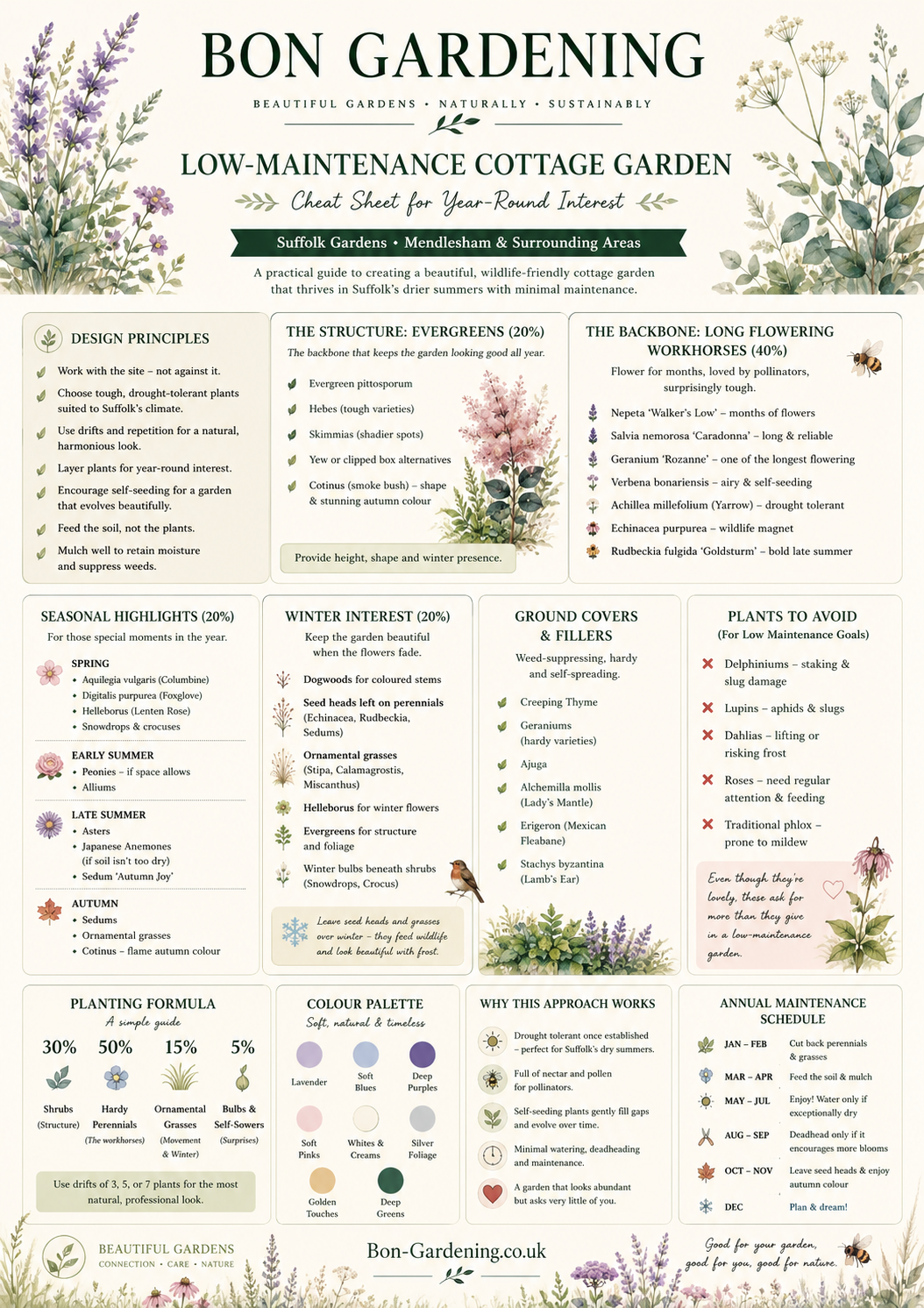
Design principles
- Work with the site — not against it.
- Choose tough, drought-tolerant plants suited to Suffolk's climate.
- Use drifts and repetition for a natural, harmonious look.
- Layer plants for year-round interest.
- Encourage self-seeding for a garden that evolves beautifully.
- Feed the soil, not the plants.
- Mulch well to retain moisture and suppress weeds.
The structure — evergreens (20%)
The backbone that keeps the garden looking good all year. Height, shape and winter presence.
- Evergreen pittosporum
- Hebes (tough varieties)
- Skimmias (shadier spots)
- Yew or clipped box alternatives
- Cotinus (smoke bush) — shape & stunning autumn colour
The backbone — long-flowering workhorses (40%)
Flower for months, loved by pollinators, surprisingly tough.
- Nepeta 'Walker's Low' — months of flowers
- Salvia nemorosa 'Caradonna' — long & reliable
- Geranium 'Rozanne' — one of the longest flowering
- Verbena bonariensis — airy & self-seeding
- Achillea millefolium (Yarrow) — drought tolerant
- Echinacea purpurea — wildlife magnet
- Rudbeckia fulgida 'Goldsturm' — bold late summer
Seasonal highlights (20%)
Spring
Aquilegia vulgaris (Columbine), Digitalis purpurea (Foxglove), Helleborus (Lenten Rose), snowdrops & crocuses.
Early summer
Peonies — if space allows — and alliums.
Late summer
Asters, Japanese anemones (if soil isn't too dry) and Sedum 'Autumn Joy'.
Autumn
Sedums, ornamental grasses and cotinus for flame autumn colour.
Winter interest (20%)
- Dogwoods for coloured stems
- Seed heads left on perennials (Echinacea, Rudbeckia, Sedums)
- Ornamental grasses (Stipa, Calamagrostis, Miscanthus)
- Helleborus for winter flowers
- Evergreens for structure and foliage
- Winter bulbs beneath shrubs (snowdrops, crocus)
Ground covers & fillers
Weed-suppressing, hardy and self-spreading.
- Creeping thyme
- Geraniums (hardy varieties)
- Ajuga
- Alchemilla mollis (Lady's Mantle)
- Erigeron (Mexican fleabane)
- Stachys byzantina (Lamb's ear)
Plants to avoid for low-maintenance goals
- Delphiniums — staking & slug damage
- Lupins — aphids & slugs
- Dahlias — lifting or risking frost
- Roses — need regular attention & feeding
- Traditional phlox — prone to mildew
A simple planting formula
30% shrubs
Structure.
50% hardy perennials
The workhorses.
15% ornamental grasses
Movement and winter form.
5% bulbs & self-sowers
Surprises.
Annual maintenance schedule
Jan – Feb
Cut back perennials & grasses.
Mar – Apr
Feed the soil & mulch.
May – Jul
Enjoy! Water only if exceptionally dry.
Aug – Sep
Deadhead only if it encourages more blooms.
Oct – Nov
Leave seed heads & enjoy autumn colour.
Dec
Plan & dream.
Use drifts of 3, 5 or 7 plants for the most natural, professional look. A garden that looks abundant but asks very little of you.
Bon Gardening Field Guides are written with Suffolk gardens in mind. Every garden is different, so these guides offer practical principles rather than fixed rules.